
Lawrence Previous-Resident Sources
No single Lawrence roll spans every era or proves every resident. The strongest record trail pairs a legal source with a people-and-place source. Begin with the row whose dates fit the question, then confirm what the record actually calls the named person.
| Source | Years covered | Where held | What it shows |
|---|---|---|---|
| Landmark deed index | Current index; pre-January 3, 1983 number warning; exact start unpublished | Douglas County Register of Deeds | Parties, record date, document type, book/page, legal search |
| Lawrence city directories | Intermittent 1860-1930; nearly complete Polk run from 1961 | LPL, Digital Douglas County History, Watkins, Spencer | Dated name/address and edition-specific household fields |
| Telephone directories | 1916; sporadic 1930s; strong 1940s-2000s run | LPL and digitized selections | Subscriber, phone, address, business listings |
| Sanborn maps and aerials | Sanborn 1883-1949; aerials from 1937 at intervals | LPL, Spencer, map collections, Atlas | Building footprint, use, lot and landscape change |
| Tax and appraisal rolls | Tax rolls 1853-1967; appraisal records 1964-1988 | Spencer, Watkins, County Appraiser | Taxpayer or owner, value, parcel context |
| Federal census | Public through 1950 | NARA and library access | Enumerated household, relationships, age, work and place |
An empty online result is a coverage problem until proven otherwise. Landmark does not publish a clean online start year. Some directory years never existed or are not held locally. Call the custodian or archive before concluding that no one was tied to the address.
Lawrence House-History Starting Desk
The Lawrence Public Library house-history guide gives a local source chain instead of a generic property-search recipe. It points to Watkins abstracts and tax rolls, Register of Deeds originals, city and telephone directories, Sanborn maps, aerial photos, and plats. A house abstract is a chronological digest of deeds, mortgages, sales, and legal proceedings. It is a lead to the original instruments, not a replacement for them.
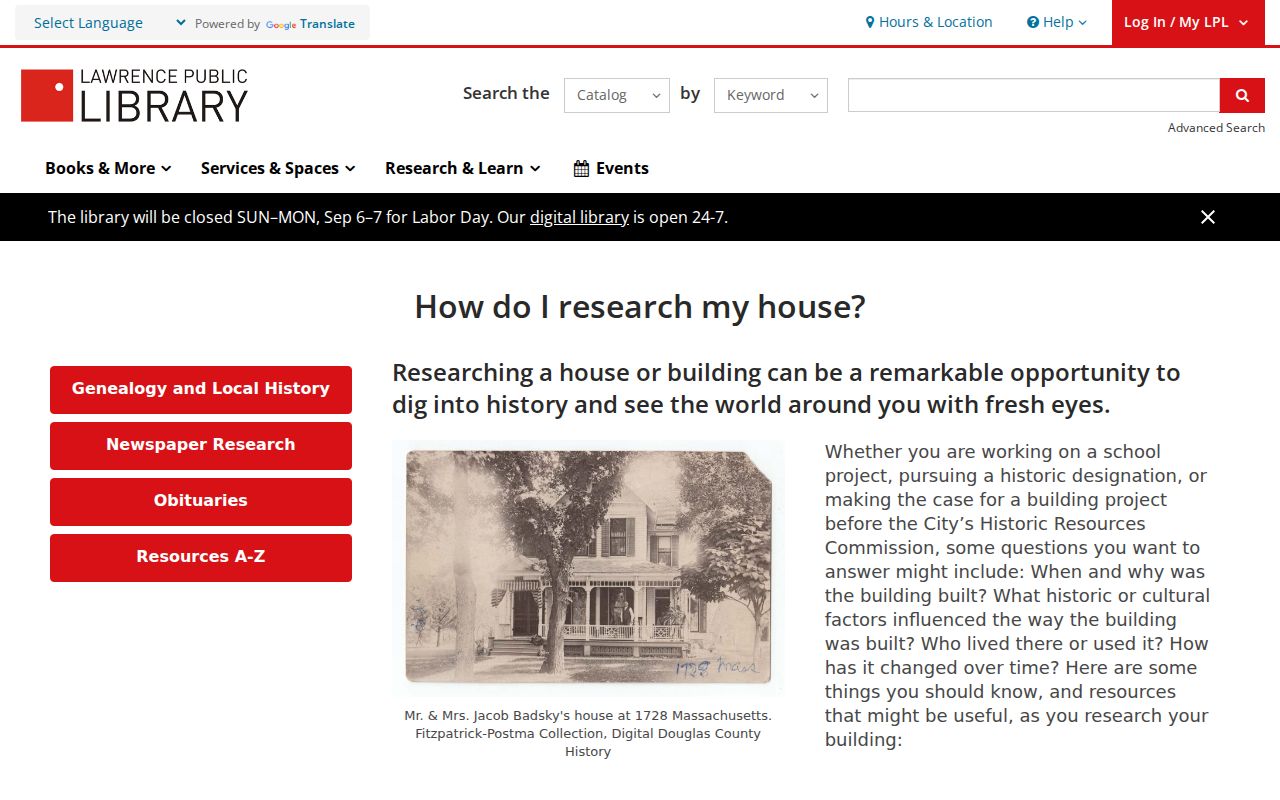
The captured guide shows why a Lawrence search can move from one address to several local collections without treating any one source as complete.
The Helen Osma Local History Room can help identify a directory volume and page through the Ask Desk, 785-843-3833, live chat, email, or Book a Librarian. Its Kansas Collection does not circulate. When remote access is unclear, ask staff before assuming that a database or scan is available from home.
Trace Douglas County Deeds Backward
Start the legal column with Douglas County Property Information. Copy the current situs, Quick Ref ID or PIN, legal description, and sales-history book/page. Then move to the Landmark index. The deed chain works backward by party role, not by guessing an old resident's name.
- Open the current parcel card and record the legal description plus each sales reference.
- Find the latest deed by book/page and copy its grantor, grantee, record date, document type, and image status.
- Search the seller, who is the grantor in that transfer, as a grantee in an earlier date range.
- Confirm that the earlier result carries the same legal description, lot/block, or subdivision.
- Repeat until the online index stops, then call or visit the Register of Deeds or consult a Watkins abstract and older deed books.
- Grantor
- The party transferring an interest in a recorded instrument.
- Grantee
- The party receiving the interest.
- Chain of title
- The ordered series of recorded transfers tied to one parcel.
- Legal description
- The land description that can survive a changed street number or street form.
The inspected Landmark sample deed entry illustrates the book/page pivot.
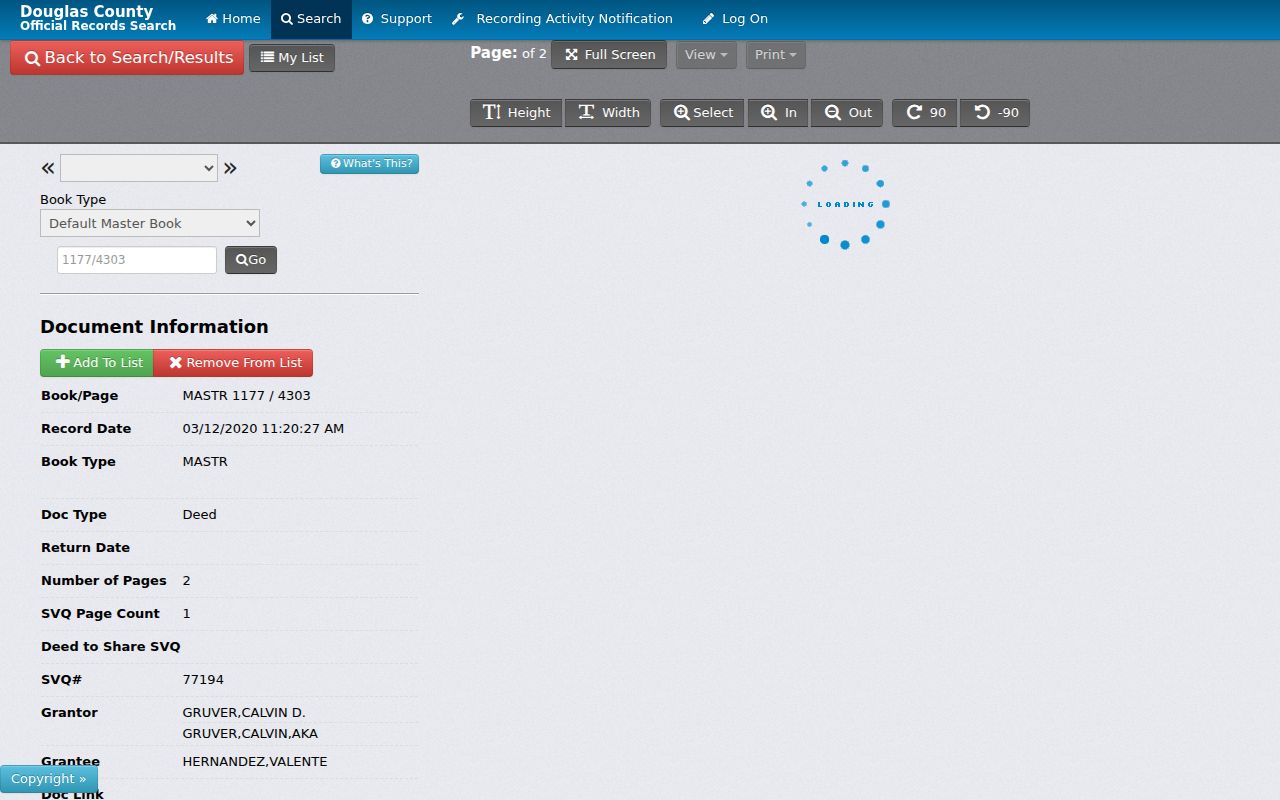
The sample displays record date, deed type, page count, and grantor/grantee roles, the core details needed to continue one step backward.
Lawrence Deed Number Quirk
Landmark warns that documents before January 3, 1983 may carry negative placeholder instrument numbers instead of true instrument numbers. Do not read that date as the start of county deeds or even as a proven start for the web index. It is a warning about one identifier.
Insider tip. Preserve book and page, party roles, record date, and legal description so a placeholder instrument number cannot break the chain.
The Douglas County Register of Deeds at 1100 Massachusetts Street is the fallback for older books, coverage questions, images, and official copies. The office page lists weekday hours of 8 a.m. to 5 p.m. and 785-832-5282. Current copy charges should be checked against the county fee schedule before ordering.
Lawrence Past Households by Year
Deeds identify recorded parties, not all previous residents. Build a second column from city directories, telephone directories, and census schedules. Later Lawrence directories may include a reverse-address section, but the exact volume should be confirmed with the Local History Room. Search the address there first, then locate each surname in the alphabetic section and preserve the year and page.
- Choose a directory year closest to the deed transfer or tax-roll entry.
- Transcribe the printed address, name, spouse notation, occupation, phone, and occupancy marks only when that edition shows them.
- Check a nearby public census year through 1950 and record the household as enumerated.
- Compare the address on a Sanborn sheet, aerial, or plat to make sure the structure and parcel stayed comparable.
- Repeat with the next directory year, labeling every result by its date and source role.
The collections and their reading conventions are treated in depth on the Lawrence city directories page. Here, their job is narrower: test who appears at one address before and after a deed, tax, or map event.
Note: A telephone listing establishes a subscriber entry, while a census establishes an enumerated household; neither should be silently relabeled.
Previous Residents at 90 Massachusetts
A vivid Lawrence example comes from the digitized 1866 city directory. Its item record identifies a circulating library and reading room over George Leis Drugstore at 90 Massachusetts. That page binds a civic or business role to a printed address. It does not prove that the named person slept there.
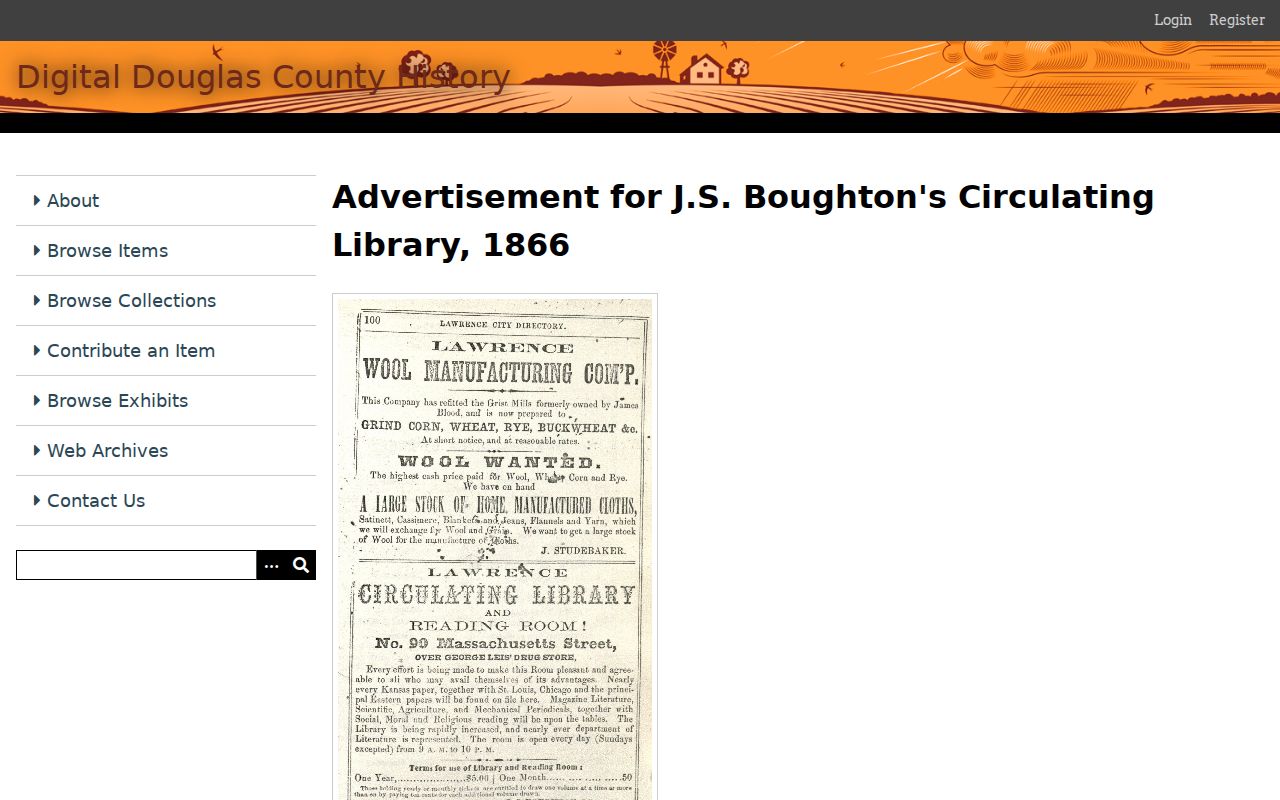
The source image makes the edition and page context visible, which is essential when a historic address is compared with later directories, deeds, or maps.
This story also shows why inclusion rules matter. The 1860-61 directory is described as listing male citizens, residences, businesses, societies, institutions, and officers. The 1875-76 edition describes residents by ethnicity, occupation, and residence. Those summaries differ. Never project one volume's fields onto another.
Map Lawrence Address Continuity
Maps answer a different question from directories. Sanborn fire-insurance sheets covering Lawrence from 1883 to 1949 show building footprints and uses. County aerials begin in 1937, continue about once per decade through 1986, and appear at intervals from 2000 through 2024. Today's parcel polygon supplies the modern lot shape and legal fields. Together they test physical continuity without naming an occupant.
Use a three-witness comparison: directory entry for the dated name and address, Sanborn or aerial sheet for the building and block, and current Atlas or parcel polygon for today's geography. If all three align, describe a dated address history. Do not turn the result into a claim about a living resident.
The county GIS can expose owner fields, situs, ZIP, deed, book/page, legal text, PID, Quick Ref ID, and geometry. Lawrence Atlas adds aerial, historic-property, floodplain, measure, draw, and print tools. Cite the layer date, because city and county layers update on different schedules.
Lawrence Archives Bridge Missing Years
The Watkins Museum research room holds Douglas County Historical Society photographs, documents, maps, clippings, oral histories, genealogy files, yearbooks, and house material. It is open Tuesday through Saturday, 10 a.m. to 4 p.m., at 1047 Massachusetts Street. Reproduction fees apply to images.

The research-page capture identifies the local archive that can bridge deed abstracts, tax material, maps, photographs, and newspaper context.
The Spencer Kansas Collection adds manuscripts, photos, maps, architectural drawings, newspapers, and territorial material from 1854 onward.
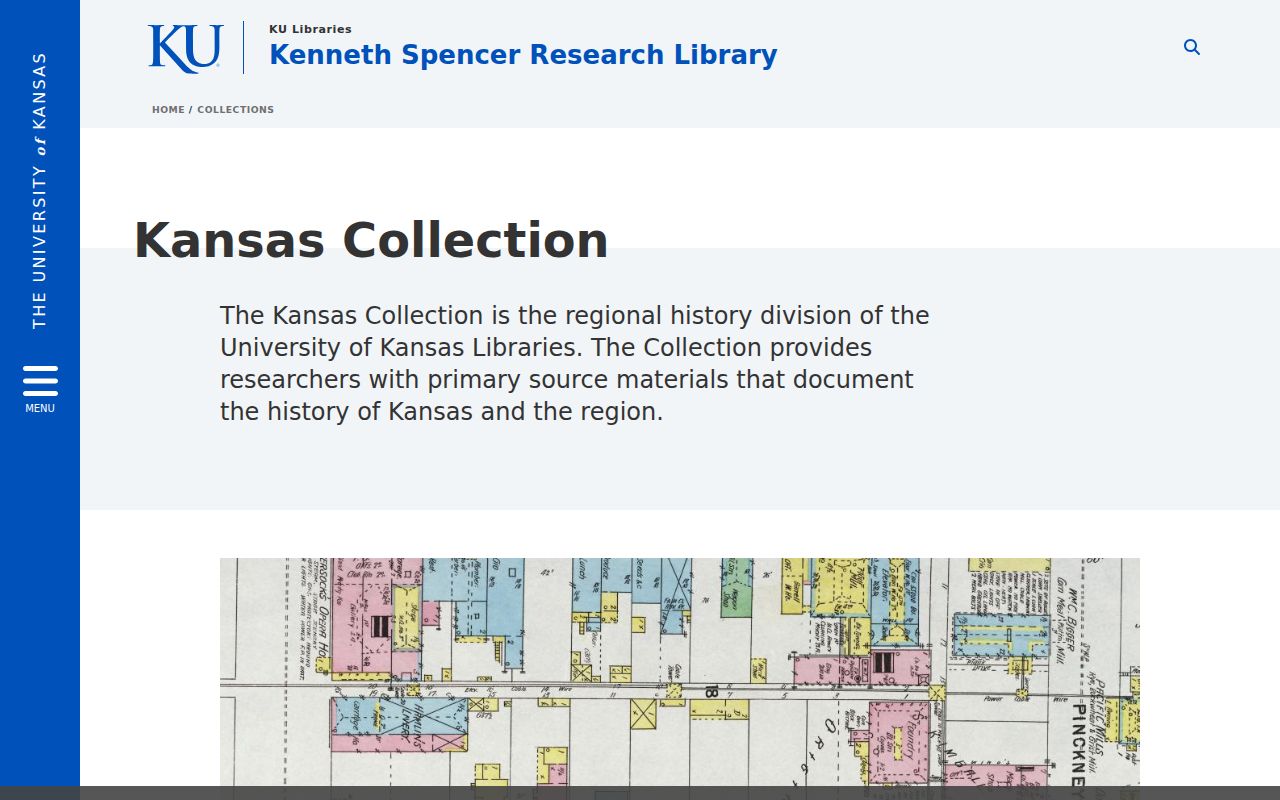
The collection overview shows the range of formats that may hold a street, household, organization, or building clue when a directory year is absent.
For exact county series, use the Spencer Douglas County records guide.
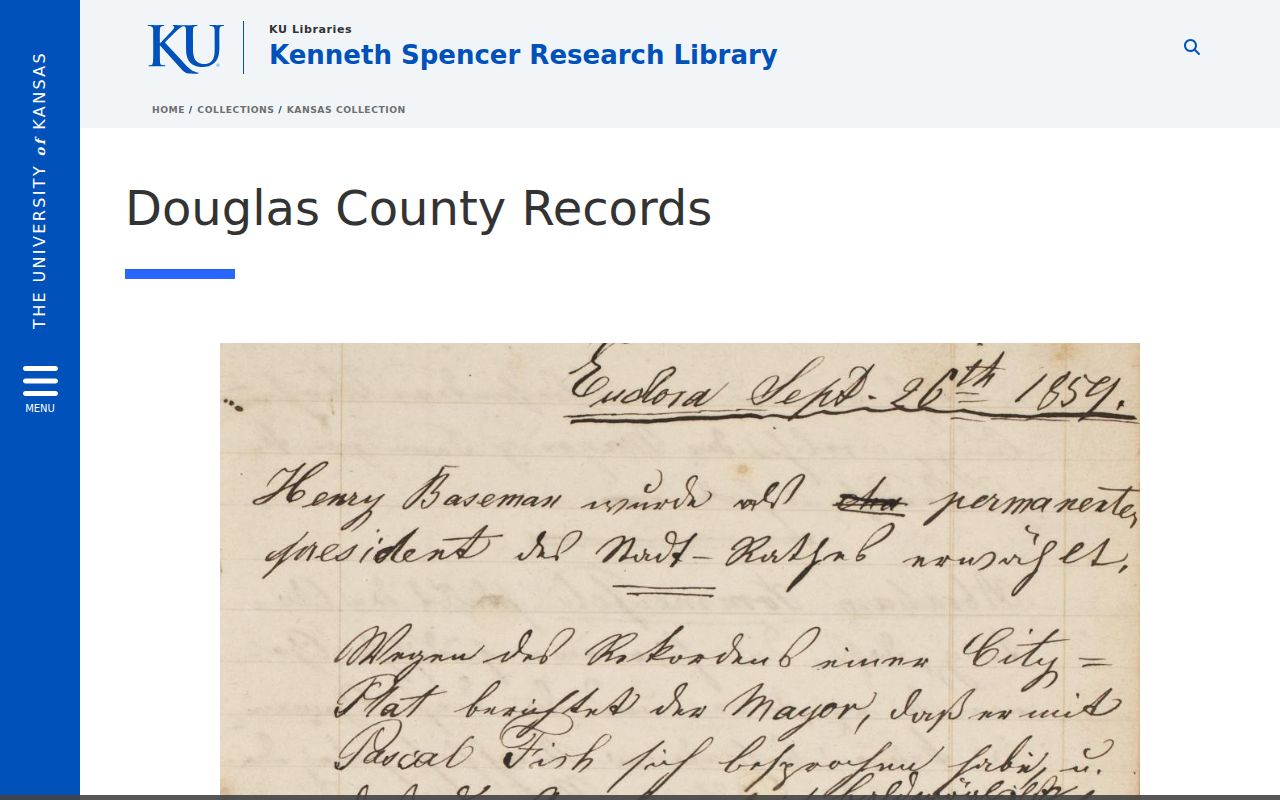
The guide supplies the critical date spans, including tax rolls from 1853 to 1967, probate indexes from 1857 to 1965, and appraisal records from 1964 to 1988.
Quantrill Gap in Lawrence Records
Spencer reports that most Douglas County court records from 1855 through 1863 were destroyed in the 1863 Quantrill raid. That is a documented loss, not a failed search term. An early Lawrence previous-resident trail may need to pivot to surviving deed books, newspapers, probate material, tax rolls, marriage indexes, directories, and later abstracts.
Lawrence Public Library's newspaper holdings begin in 1854, and its marriage index covers 1854 through 1992. Spencer probate journals begin in 1855, while district-court journals resume in 1863. State and federal archives can help with naturalization and census leads. State clearly whether a found item is an index, image, abstract, transcript, or original record.
Note: A recorded archive gap should remain in the final timeline rather than being filled with an unsupported name or assumed transfer.
Close Lawrence Resident Timelines
Obituaries, mortuary indexes, cemetery records, and probate can explain why a former resident disappears from an address. Digital Douglas County History includes obituary and mortuary collections. Lawrence Public Library holds newspapers through February 2013 on microfilm and provides a clipping index. Spencer probate indexes and journals cover long local runs, though access limits apply to protected matters.
Match each endpoint with care. A cemetery database establishes burial information. An obituary may state relationships and a prior address. A probate entry identifies an estate case. A directory gives a dated listing. These sources can corroborate one another, but none should be rewritten as a vital certificate.
Lawful use. Research previous residents for family or house history, and never use an address trail to track, harass, or harm a living person.